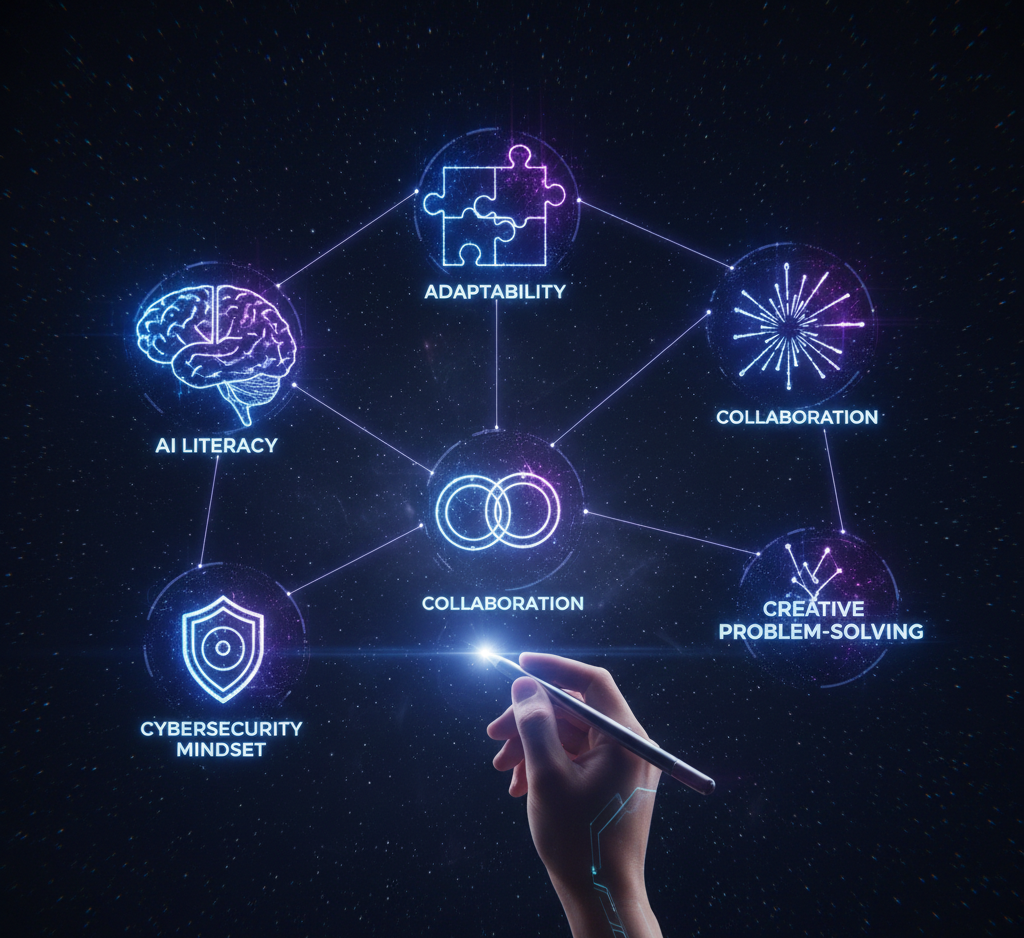
Introduction: The American Job Market is Evolving – Are You?
The American workplace is undergoing its most significant transformation in decades. With rapid AI adoption, shifting work models, and evolving economic priorities, the skills that guaranteed success in 2020 are no longer sufficient for 2025. Whether you’re a recent college graduate in Austin, a mid-career professional in Chicago, or an aspiring immigrant navigating the US job market, understanding this shift is critical.
Based on insights from LinkedIn’s Workforce Report, the World Economic Forum, and hiring trends at leading US companies like Google, JPMorgan Chase, and Pfizer, this article outlines the top five skills US employers will prioritize in 2025. More than just a list, we provide a practical, step-by-step guide on how to build and demonstrate these competencies, making you a compelling candidate for top-tier American employers.
1. AI & Machine Learning Fluency (Beyond the Basics)
In the US, AI is moving from a specialized tech skill to a core business competency. Employers now seek “AI fluency”—the ability to understand, interact with, and leverage AI tools to enhance productivity and innovation across all functions.
Why US Employers Want It: From Wall Street firms using AI for algorithmic trading to pharmaceutical companies accelerating drug discovery, AI integration is a strategic priority. Companies need employees who can use tools like ChatGPT for Enterprise, Microsoft 365 Copilot, and AI-powered CRMs to solve complex problems.
How to Develop It for the US Market:
- Go Beyond Chatbots: Learn to use AI for specific professional tasks. Use Github Copilot if you code, Runway ML for creative work, or Salesforce Einstein for sales analytics.
- Understand the Ethics: US companies are heavily focused on Responsible AI. Take free courses on AI ethics from Stanford Online or MIT OpenCourseWare to understand bias, privacy, and transparency.
- Get Certified: Pursue recognized certifications like Google’s Generative AI Microlearning path or IBM’s AI Foundations for Business on Coursera to add credibility.
2. Cybersecurity Awareness & Digital Hygiene
As cyber threats grow more sophisticated, every employee becomes a frontline defender. US employers, especially in finance, healthcare, and critical infrastructure, prioritize candidates who understand cybersecurity fundamentals.
Why US Employers Want It: A single phishing email can cost millions. Companies invest heavily in training but prefer to hire people who already possess strong digital hygiene—knowledge of secure practices, password management, and data protection principles.
How to Develop It for the US Market:
- Earn Foundational Certs: Obtain entry-level certifications like CompTIA Security+ or Google’s Cybersecurity Professional Certificate on Coursera. These are highly respected in the US.
- Practice Safe Habits: Use a password manager (like 1Password or LastPass), enable two-factor authentication (2FA) everywhere, and learn to identify phishing attempts.
- Understand Compliance: Familiarize yourself with key US regulations like HIPAA (for healthcare) or GDPR/CCPA (for data privacy), relevant to your industry.
3. Interdisciplinary Problem-Solving
The era of siloed expertise is ending. US companies face complex challenges that sit at the intersection of technology, business, and human behavior. They value talent who can bridge these gaps.
Why US Employers Want It: Launching a new product requires tech knowledge, market understanding, and user experience design. Solving supply chain issues needs logistics, data analysis, and sustainability insights. Employees who can connect dots across disciplines drive innovation.
How to Develop It for the US Market:
- Build a “T-Shaped” Skill Set: Deepen your core expertise (the vertical of the T), but also broaden your knowledge. A software engineer could learn basic UX design principles; a marketer could learn SQL for data extraction.
- Work on Cross-Functional Projects: Volunteer for projects outside your department in your current role. If not possible, contribute to open-source projects or hackathons that require diverse skills.
- Consume Diverse Content: Follow thought leaders and read publications outside your field (e.g., a developer reading Harvard Business Review).
4. Remote Collaboration & Asynchronous Communication Mastery
The hybrid/remote model is permanent for many US companies. Mastery of asynchronous work—communicating and collaborating effectively across time zones without real-time interaction—is now a baseline requirement.
Why US Employers Want It: Teams are often spread across the US and globally. Employers need professionals who can manage projects, write clear documentation, and build rapport without constant meetings, ensuring productivity in a flexible model.
How to Develop It for the US Market:
- Master the Tools: Become proficient in Slack (for async updates), Loom (for video messages), Confluence or Notion (for documentation), and project management software (Asana, Jira).
- Hone Your Writing: Learn to write clear, concise, and action-oriented emails and documentation. Tools like Grammarly can help. Remember, in async work, your writing is your presence.
- Proactively Manage Projects: Practice creating project timelines, setting clear expectations, and providing status updates without being prompted.
5. Adaptability Quotient (AQ) & Continuous Learning
In a market defined by disruption, your Adaptability Quotient (AQ)—your ability to adjust to change, learn quickly, and apply new knowledge—is becoming as important as IQ or EQ.
Why US Employers Want It: Technologies evolve, business models pivot, and market demands shift overnight. Companies like Amazon and Netflix prioritize “learn-it-all” over “know-it-all” cultures. They seek hires who are curious, resilient, and self-directed learners.
How to Develop It for the US Market:
- Cultivate a Learning Routine: Dedicate 5 hours per week to deliberate learning via platforms like LinkedIn Learning, Udemy, or edX. Follow the 70-20-10 rule (70% on-the-job, 20% social learning, 10% formal courses).
- Embrace Micro-Experiments: Regularly try new tools or methods in your work. Did a new SaaS tool catch your eye? Try its free trial on a small task.
- Build a “Learning Portfolio”: Document your new skills. Write LinkedIn posts summarizing what you learned from a course or project. This demonstrates AQ tangibly.
Conclusion: Your Action Plan for the 2025 US Job Market
Preparing for the US job market of 2025 is not about a frantic last-minute upskilling spree. It’s about intentional, continuous growth. Start today by conducting a personal skills audit against these five areas.
Your 3-Month Plan:
- Month 1: Pick one technical skill (AI or Cybersecurity) and one human skill (Async Communication or AQ).
- Month 2: Enroll in one credible course for each. Apply the learning to a small, real-world project.
- Month 3: Update your LinkedIn profile and resume with these new competencies. Use the STAR method (Situation, Task, Action, Result) to frame your experience.
Remember, American employers value demonstrated initiative. Your journey of learning itself is a powerful signal of your potential.
Ready to Showcase Your New Skills to US Employers?
Take the next step in your American career journey. Explore thousands of opportunities with US employers who value future-ready skills on [Your Job Portal Name]. Create a detailed profile, highlight your adaptive skill set, and connect with recruiters looking for talent prepared for 2025 and beyond.
FAQs for the US Job Market
Q1: I’m an international candidate. How do I prove these skills to US employers?
Build a public portfolio. Contribute to GitHub (for tech), publish case studies on Medium or LinkedIn, or create a personal website showcasing projects. Use the US-specific platforms and certifications mentioned above. Network actively on LinkedIn with professionals in your target companies.
Q2: Are these skills relevant for non-tech roles in the USA?
Absolutely. These are meta-skills. A US-based HR manager needs cybersecurity awareness to protect employee data. A supply chain manager uses AI for demand forecasting. A marketing manager must master async collaboration with agencies and team members.
Q3: How important are traditional degrees versus these skills in the US now?
While degrees from accredited institutions remain important for visa processes and certain fields, skills-based hiring is accelerating. Many US companies, including giants like Google and IBM, have dropped degree requirements for numerous roles, prioritizing demonstrable skills and portfolios instead.
Q4: What’s the single best way to demonstrate “Adaptability Quotient” in an interview?
Tell a compelling story using the STAR method about a time you faced a significant change or learned a new skill under pressure. Focus on your learning process, your mindset, and the positive outcome you achieved through adaptation.