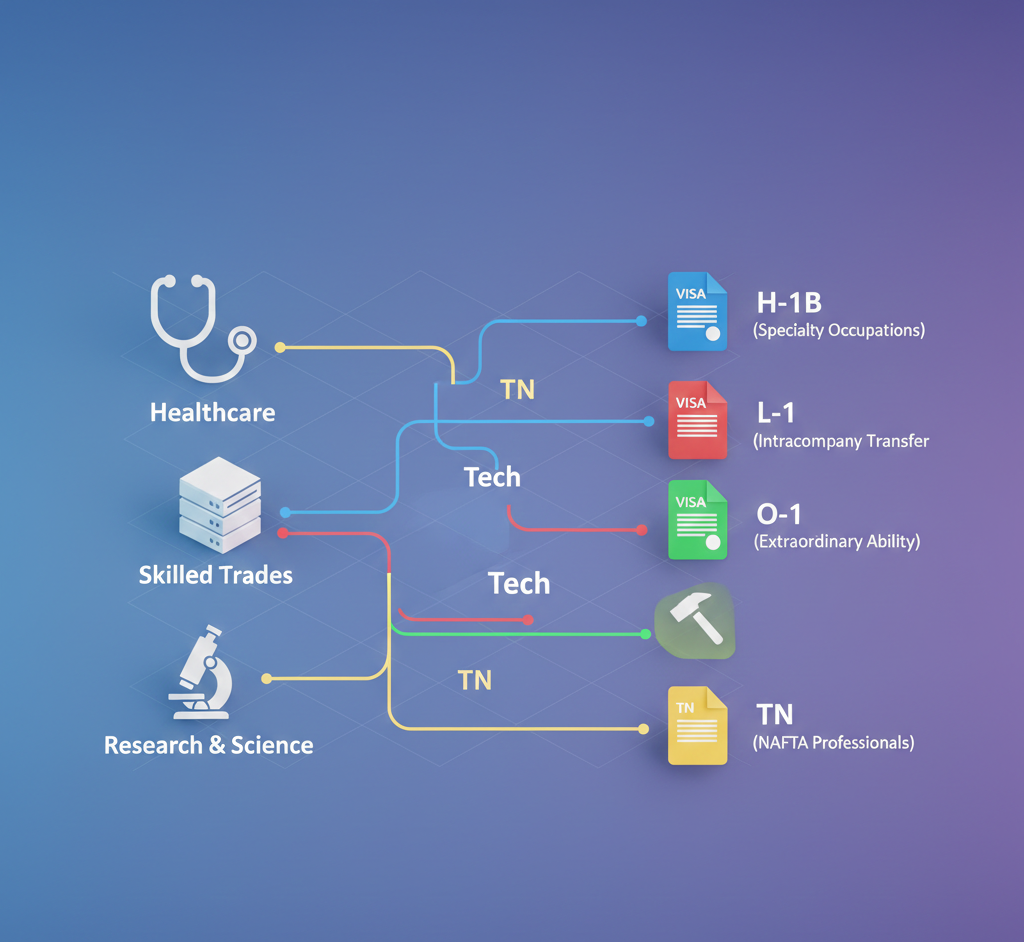
Introduction: Understanding America’s Diverse Employment Landscape
The United States job market isn’t a monolith—it’s a complex ecosystem of different employment types, each with unique requirements, benefits, and pathways. For international professionals, understanding these categories is more than academic; it’s essential for strategic career planning. Whether you’re a software engineer eyeing Silicon Valley, a nurse considering opportunities in Texas, or a professor aiming for Ivy League institutions, the type of job you pursue determines your visa options, salary expectations, and career trajectory.
This comprehensive guide breaks down the major categories of employment in the USA, examining everything from high-demand tech roles to specialized positions that offer easier immigration pathways. We’ll explore industry trends, salary benchmarks, visa sponsorship likelihood, and growth prospects for each category, giving you the knowledge to make informed decisions about your American career journey.
Category 1: Tech & IT Jobs – The H-1B Powerhouse
Overview
The technology sector remains the most accessible pathway for international professionals, accounting for approximately 70% of all H-1B visa petitions. From established giants in Silicon Valley to thriving startups in Austin, this sector values global talent.
Key Roles & Salaries (2024 Estimates):
- Software Engineers/Developers: $120,000 – $250,000+
- Data Scientists: $130,000 – $220,000
- DevOps Engineers: $125,000 – $210,000
- Cybersecurity Analysts: $110,000 – $190,000
- Product Managers: $140,000 – $300,000+
Visa Pathways:
- H-1B: Most common, but subject to annual lottery
- L-1: For intra-company transfers
- O-1: For extraordinary ability
- TN: Specifically for Canadian/Mexican citizens
Industry Hotspots:
- Traditional Tech: Silicon Valley, Seattle, Austin
- Emerging Hubs: Miami, Atlanta, Denver
- Specialized: Boston (biotech), Los Angeles (gaming)
Entry Strategies:
- Target companies with proven H-1B sponsorship records
- Consider master’s programs in STEM for 3-year OPT extension
- Explore consulting firms (WITCH companies) as potential entry points
Category 2: Healthcare & Medical Jobs – The Green Card Fast Track
Overview
The US healthcare system faces severe staffing shortages, creating exceptional opportunities for international medical professionals. Many healthcare roles qualify for EB-3 Green Cards without lengthy labor certification processes.
Key Roles & Salaries:
- Registered Nurses: $75,000 – $140,000 (Varies by state)
- Physicians/Specialists: $250,000 – $500,000+
- Physical Therapists: $85,000 – $120,000
- Medical Technologists: $65,000 – $95,000
- Healthcare Administrators: $90,000 – $180,000
Critical Advantages:
- Schedule A Occupations: Nurses and physical therapists qualify for faster Green Card processing
- State-Specific Licensing: Some states (like Texas, Florida) have more accessible licensing for foreign-trained professionals
- Rural Opportunities: J-1 visa waiver programs for underserved areas
Licensing Pathways:
- Nurses: NCLEX exam + CGFNS certificate + State Board approval
- Doctors: USMLE Steps 1-3 + Residency matching
- Allied Health: Specific certification exams per specialty
Category 3: Academic & Research Positions – The J-1/F-1 Pathway
Overview
American universities and research institutions offer unique opportunities through non-immigrant scholar visas that can transition to permanent status.
Position Types:
- Tenure-Track Faculty: Highly competitive, usually requiring EB-1/EB-2
- Postdoctoral Researchers: Common entry point, typically J-1 or H-1B
- Visiting Scholars: J-1 visa for 1-3 year appointments
- University Staff: H-1B for administrative/technical roles
Salary Ranges:
- Assistant Professors: $80,000 – $120,000
- Postdoctoral Fellows: $55,000 – $75,000
- Research Scientists: $70,000 – $130,000
Unique Benefits:
- J-1 Visa: Often leads to waiver opportunities through Conrad 30 program
- Cap-Exempt H-1B: Universities are exempt from H-1B lottery
- EB-1B: Special Green Card category for outstanding researchers
Category 4: Business & Management Roles – The L-1 Avenue
Overview
Multinational corporations offer excellent pathways through intra-company transfer visas, particularly for managers and executives.
Common Positions:
- Regional/Country Managers: L-1A visa for executives
- Specialized Knowledge Workers: L-1B for technical/specialized roles
- Consultants: H-1B or L-1 depending on engagement
- Financial Analysts/Accountants: H-1B for specialized positions
Strategic Approaches:
- Build Experience with MNCs in your home country first
- Target companies with substantial US operations
- L-1 to EB-1C: Direct path from L-1A manager to Green Card
Salary Benchmarks:
- Mid-Level Managers: $100,000 – $180,000
- Senior Executives: $200,000 – $500,000+
- Management Consultants: $150,000 – $300,000
Category 5: Trades & Skilled Labor – The EB-3 Alternative
Overview
Often overlooked, skilled trades offer surprisingly good immigration pathways through the EB-3 “Other Workers” category.
In-Demand Trades:
- Electricians & Plumbers: State licensing required
- HVAC Technicians: High demand year-round
- Construction Supervisors: Especially with bilingual skills
- Industrial Mechanics: Manufacturing sector needs
Visa Considerations:
- PERM Labor Certification: Required but achievable for truly hard-to-fill positions
- Regional Variations: Higher demand in growing states (Texas, Florida, Tennessee)
- Union vs Non-Union: Unionized positions often have clearer pathways
Category 6: Creative & Entertainment Industry – The O-1/B-1 Route
Overview
For artists, designers, and entertainment professionals, the O-1 “extraordinary ability” visa offers possibilities without lottery restrictions.
Applicable Fields:
- Graphic/UX Designers: With substantial portfolio
- Film/TV Professionals: With proven credits
- Fashion Industry: Designers, stylists, photographers
- Musicians/Performers: Touring or contracted positions
Key Requirements:
- Evidence of “Extraordinary Ability”: Awards, publications, high salary, critical role
- Agent/Sponsor: US-based employer or agent required
- P-3 Visa: For culturally unique programs
Category 7: Remote & Contract Work – The Evolving Landscape
The New Frontier
Post-pandemic, many international professionals work for US companies while residing elsewhere through:
Models:
- Employer of Record (EOR): Companies like Remote.com or Deel handle compliance
- Contract/Consulting: 1099 positions (limited visa options)
- Digital Nomad Visas: Some states developing specific programs
Considerations:
- Tax Implications: Complex international tax situations
- Visa Limitations: Most require physical presence for traditional work visas
- Future Trends: Potential legislative changes for digital workers
Comparative Analysis: Choosing Your Path
Visa Success Probability Matrix:
- Highest: Healthcare (Schedule A), University (Cap-Exempt), L-1 Transfers
- High: Tech (H-1B lottery dependent), O-1 Extraordinary Ability
- Medium: Skilled Trades (PERM dependent), Business Roles
- Variable: Creative Fields (portfolio dependent)
Timeline Expectations:
- Fastest to Start: J-1 Research, OPT STEM extensions
- 6-12 Months: H-1B (if lottery successful), L-1 Transfers
- 12-24 Months: Green Card through EB-2/EB-3 PERM
- Immediate: TN visas for Canadians/Mexicans
Geographic Strategy:
- Tech: Concentrated in specific hubs
- Healthcare: Nationwide opportunities
- Academic: Quality over geography
- Trades: Following construction/development hotspots
Actionable Steps for Each Category
Week 1-2: Research Phase
- Identify which category matches your qualifications
- Research specific license/certification requirements
- Create target company list with sponsorship history
Week 3-4: Documentation Phase
- Get credentials evaluated (if needed)
- Prepare category-specific resume/portfolio
- Begin networking with professionals in your target category
Month 2-3: Application Phase
- Apply strategically based on visa cycle timing
- Consider parallel paths (e.g., student visa as backup)
- Engage immigration attorney for complex categories
Future Trends: What’s Changing in 2025-2030
Emerging Opportunities:
- Green Energy Jobs: Solar/wind technician roles
- AI Ethics & Governance: New regulatory positions
- Telehealth Professionals: Cross-border medicine
- Climate Adaptation Specialists: Engineering and policy roles
Policy Changes to Watch:
- H-1B Modernization: Potential wage-based selection
- STEM Expansion: Additional fields qualifying for OPT extension
- Startup Visas: Proposed International Entrepreneur Rule expansion
Salary Evolution:
- Continued growth in tech but with geographic dispersion
- Healthcare salaries increasing due to demand
- Trades seeing above-inflation wage growth
Conclusion: Building Your American Career Strategy
The United States offers multiple pathways for international talent, but success requires strategic categorization. You’re not just looking for “a job in America”—you’re targeting a specific type of employment that aligns with your background and offers viable immigration options.
Begin by honestly assessing which category fits your profile best. A software developer with 3 years of experience has a very different pathway than a nurse with 10 years of experience, though both are in high demand. Consider hybrid approaches—pursuing a master’s degree to access STEM OPT while targeting healthcare IT roles, for example.
Remember that immigration policy evolves. What’s challenging today might become easier tomorrow, and vice versa. Build a flexible skill set that allows you to pivot between related categories if needed.
Final Checklist:
- I’ve identified my primary employment category
- I understand the specific visa requirements
- I’ve researched license/certification needs
- I know the geographic hotspots for my field
- I have a timeline that accounts for processing delays
- I’ve consulted with an immigration professional
Your American career journey starts with this crucial categorization step. Choose wisely, prepare thoroughly, and pursue persistently.
Need Help Navigating Your Specific Category?
Explore detailed job listings filtered by visa sponsorship type on [Your Job Portal Name]. Our platform categorizes opportunities by employment type, making it easier to find positions that match your immigration pathway. Create your profile today and connect with employers actively seeking international talent in your specific category.
FAQs: US Job Categories
Q1: Which job category has the fastest path to Green Card?
Healthcare Schedule A positions (nurses, physical therapists) generally have the fastest processing as they skip the PERM labor certification step, potentially completing in 1-2 years versus 2-4 years for other categories.
Q2: Can I switch job categories after coming to the US?
Yes, but with limitations. H-1B transfers allow movement within similar occupational categories. Changing from tech to healthcare would likely require new education/licensing and potentially restarting the immigration process.
Q3: Are salaries really that different between categories?
Significantly. Tech roles in high-cost areas can pay 3-4 times what some skilled trades pay in rural areas. However, consider cost of living—$100,000 in Texas goes further than $150,000 in San Francisco.
Q4: Which categories are most future-proof against automation?
Healthcare (especially hands-on care), skilled trades (construction, maintenance), and roles requiring high-level human judgment (strategic management, creative direction) are considered most resilient.