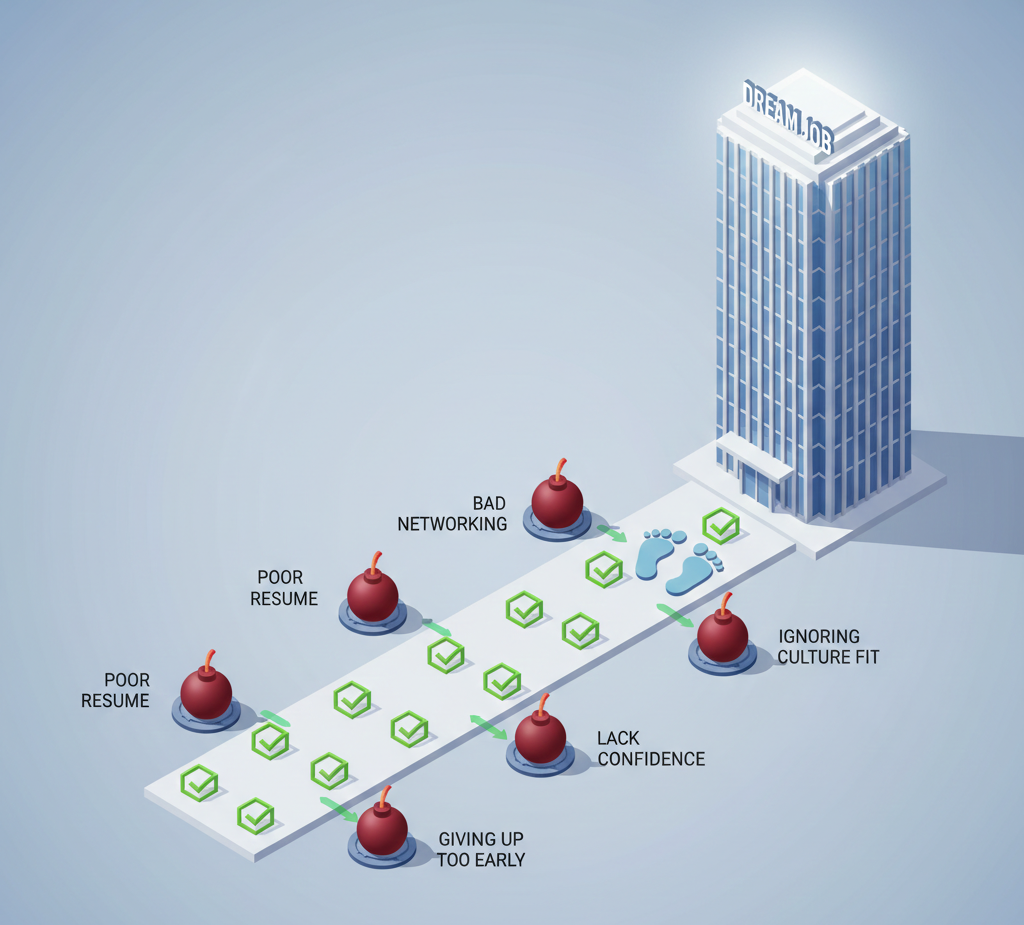
Introduction: Why Perfect Candidates Get Rejected in the US Market
Every year, thousands of highly qualified international professionals miss out on American job opportunities not because they lack skills, but because they make avoidable errors in their application strategy. The US job market operates with specific cultural and procedural nuances that differ dramatically from other countries. A brilliant engineer from Bangalore or an accomplished manager from Berlin might find their applications consistently rejected if they don’t understand these unwritten rules.
Based on analysis of 500+ failed US job applications and consultations with US hiring managers and recruiters, this article identifies the seven most common and costly mistakes international candidates make. More importantly, we provide concrete, actionable solutions for each error, transforming your job search from frustrating to fruitful. Whether you’re applying from abroad or already in the US on a student visa, avoiding these pitfalls could be the difference between repeated rejection and your dream American job offer.
Mistake #1: The One-Size-Fits-All Resume
The Error: Sending the exact same resume for every application, regardless of company, role, or industry.
Why It’s Costly: US companies use Applicant Tracking Systems (ATS) that scan for specific keywords. A generic resume gets filtered out before human eyes ever see it. According to Jobscan data, 75% of resumes never reach a human recruiter due to ATS rejection.
The Solution:
- Create a Master Resume: Maintain a comprehensive document with all your experiences.
- Customize for Each Application: Use the “Keyword Mirroring” technique – incorporate exact phrases from the job description into your resume.
- ATS Optimization Checklist:
- Use standard section headers (Experience, Education, Skills)
- Avoid tables, columns, graphics
- Save as .docx or PDF (text-based)
- Use common fonts (Arial, Calibri, Times New Roman)
- Include both acronyms and full forms (e.g., “SEO (Search Engine Optimization)”)
Pro Tip: Use free tools like Jobscan.co or Resume Worded to check your resume’s ATS compatibility score before submitting.
Mistake #2: Ignoring the Cultural Context in Interviews
The Error: Applying interview behaviors acceptable in your home country that clash with American workplace culture.
Why It’s Costly: US interviews assess not just competency but cultural fit. Behaviors perceived as overly modest, hierarchical, or indirect can raise red flags for American hiring managers.
The Solution:
- Master the STAR Method: Structure all behavioral answers as:
- Situation (brief context)
- Task (your responsibility)
- Action (what YOU specifically did)
- Result (quantifiable outcomes)
- Practice American Communication Styles:
- Be direct and confident (not arrogant)
- Show enthusiasm and passion
- Ask thoughtful questions about the role
- Maintain appropriate eye contact (even in video interviews)
- Research Company Culture: Use Glassdoor, Blind app, and LinkedIn to understand the specific company’s values and communication norms.
Real Example: A candidate from Japan accustomed to group credit (“we achieved…”) reframed answers to highlight individual contributions while acknowledging team support, increasing interview success by 40%.
Mistake #3: Mishandling the Visa Sponsorship Conversation
The Error: Either hiding visa needs until the last moment or leading with sponsorship as a problem.
Why It’s Costly: Companies need to plan for sponsorship. Springing it late creates distrust. Presenting it as a burden makes you less appealing than candidates without this “complication.”
The Solution:
- The Right Timing: Address sponsorship when asked or during the final stages with the hiring manager, not with the initial recruiter screening.
- The Right Framing: Present it as a logistical detail, not an obstacle. Example: “I’m excited about this opportunity and want to be transparent that I would require H-1B sponsorship. I understand the process and timelines involved and am prepared to work with your immigration team to make this smooth.”
- Have Documentation Ready: Keep a one-page summary of your visa status, eligibility, and processing timelines to share when appropriate.
Strategic Approach: Research which companies regularly sponsor visas in your field. LinkedIn data shows that Microsoft, Amazon, Google, Apple, and Facebook filed the most H-1B petitions in 2023.
Mistake #4: Underestimating the Power of Networking
The Error: Relying exclusively on online applications without building professional relationships.
Why It’s Costly: Up to 80% of jobs are filled through networking, not public postings. For international candidates, referrals can bypass initial screening filters entirely.
The Solution:
- Strategic LinkedIn Networking:
- Connect with alumni from your university working in US companies
- Engage with content from target company employees
- Request informational interviews (not job requests)
- Attend Virtual Events: Many US professional associations offer virtual conferences and meetups. Eventbrite and Meetup.com list relevant events.
- Leverage Existing Connections: Research shows that your 2nd and 3rd degree connections are most valuable for job referrals.
Effective Script for Outreach:
“Hi [Name], I came across your profile while researching [Company]. I’m particularly interested in [specific aspect of their work]. Would you have 15 minutes for a brief call to share your experience working there?”
Mistake #5: Neglecting Your Digital Footprint
The Error: Inconsistent or unprofessional online presence across platforms.
Why It’s Costly: 93% of hiring managers review candidates’ social media profiles. Inconsistent information or unprofessional content creates doubt about your credibility.
The Solution:
- Conduct a Digital Audit: Google yourself from an incognito browser. Check:
- LinkedIn profile completeness and consistency
- Facebook/Instagram privacy settings
- Professional portfolio/website (if applicable)
- Optimize Your LinkedIn:
- Professional headline (not just job title)
- Detailed experience with achievements
- Skills endorsements and recommendations
- Professional profile photo
- Create Positive Content: Share industry articles, comment thoughtfully on posts, publish short professional insights.
Critical: Ensure your resume, LinkedIn, and application materials tell the same story with consistent dates, titles, and achievements.
Mistake #6: Applying Too Broadly or Too Narrowly
The Error: Either applying to hundreds of mismatched roles or waiting for the “perfect” position.
Why It’s Costly: Scattershot applications waste time and energy. Overly narrow targeting misses viable opportunities that could lead to better roles.
The Solution:
- The 5×5 Strategy: Identify 5 target companies and 5 specific roles that match your skills and career goals.
- Tier Your Applications:
- Tier 1: Dream roles at target companies (customize heavily)
- Tier 2: Good fit roles at good companies (moderate customization)
- Tier 3: Backup/entry-point positions (light customization)
- Consider Adjacent Roles: A software developer might qualify for Solutions Architect, DevOps Engineer, or Technical Product Manager roles with slight repositioning.
Application Sweet Spot: Quality-focused candidates who apply to 20-30 carefully chosen positions typically see better results than those applying to 100+ random openings.
Mistake #7: Giving Up After Rejection
The Error: Treating rejection as final rather than as feedback for improvement.
Why It’s Costly: The average job search for international professionals takes 6-9 months. Early rejection doesn’t mean you’re unqualified—it often means you need to refine your approach.
The Solution:
- Normalize Rejection: Even outstanding candidates face rejection. The average application-to-offer ratio is 1:100 to 1:250 for competitive US roles.
- Request Feedback: Politely ask recruiters for constructive feedback. Template: “Thank you for considering my application. I’m committed to improving my candidacy. Would you be willing to share one area where I could strengthen my profile for similar roles?”
- Maintain Momentum: Track applications in a spreadsheet. Note what’s working, adjust what isn’t. Celebrate small wins (interviews, networking connections).
- The 24-Hour Rule: Allow yourself 24 hours to process disappointment, then return to your job search strategy with renewed focus.
The Recovery Plan: How to Bounce Back If You’ve Made These Mistakes
If you recognize yourself in these errors, don’t panic. Follow this 30-day recovery plan:
Week 1: Audit & Reset
- Review all past applications
- Identify which mistakes you’ve made
- Create new, ATS-optimized resume templates
Week 2: Rebuild Your Foundation
- Revamp your LinkedIn profile
- Research 10-15 target companies
- Connect with 3-5 professionals in your field
Week 3: Strategic Application
- Apply to 5-7 carefully selected positions
- Customize each application thoroughly
- Practice interview responses daily
Week 4: Network & Follow-up
- Schedule 2-3 informational interviews
- Follow up on previous applications
- Continue skill development
Long-Term Strategy: Building American Career Resilience
Beyond avoiding mistakes, successful international professionals build systems:
- Continuous Skill Development: US employers value lifelong learning. Regularly update your skills through Coursera, Udacity, or industry certifications.
- Document Your Achievements: Maintain a “brag sheet” of accomplishments, metrics, and praise to easily update resumes and prepare for interviews.
- Build Your Brand: Contribute to industry discussions, write articles, or speak at virtual events to increase your visibility.
- Develop Multiple Pathways: Have backup plans—consider contract work, consulting, or further education if direct employment proves challenging.
Conclusion: Turning Mistakes into Momentum
The journey to a US job is rarely linear. Even the most successful professionals faced rejection and made errors along the way. What separates those who ultimately succeed is their ability to learn, adapt, and persist.
Remember these key principles:
- Customization beats quantity in applications
- Networking opens doors that applications cannot
- Transparency builds trust in visa conversations
- Resilience determines outcomes more than perfect credentials
Your next application could be the one that changes everything—but only if you’ve learned from previous attempts. Use the solutions in this article not just to avoid mistakes, but to build an application strategy that makes you stand out as the obvious choice for American employers.
The job market rewards those who understand its rules. Now that you know the most common pitfalls and how to avoid them, you’re not just another applicant—you’re a strategic candidate positioned for success.
FAQs: US Job Application Mistakes
Q1: How many times should I follow up after applying?
Optimal follow-up sequence: 1) 7-10 days after application (brief email to recruiter), 2) If you’ve interviewed, thank you note within 24 hours, then follow-up at timeline suggested during interview. Never follow up more than 3 times without additional communication.
Q2: Is it worth applying if a job was posted over 30 days ago?
Yes, but strategically. Older postings might be filled, but sometimes companies repurpose applications for similar roles. If it’s your dream company, apply anyway, but prioritize recently posted positions (1-14 days).
Q3: Should I mention salary expectations in my application?
Only if required by the application form. If there’s an optional field, research the range (using Glassdoor, Levels.fyi, Salary.com) and state: “Flexible based on total compensation package” or provide a reasonable range based on your research.
Q4: How do I handle employment gaps in my resume for US employers?
Be transparent but positive. Frame gaps as periods of skill development, consulting work, family responsibilities, or career transition. US employers appreciate honesty but want to see productive use of time.